
Find out why exposure to the sun accelerates collagen loss and what steps you can take to better protect your skin.
Chaque été, nous profitons du soleil pour nous détendre, voyager ou passer davantage de temps en extérieur. Pourtant, cette saison est aussi celle où notre peau est la plus exposée aux agressions responsables du vieillissement cutané.
Whilst a tan often makes the skin appear more radiant, the invisible effects of the sun are quite different. Ultraviolet (UV) rays, heat, dehydration and oxidative stress accelerate the breakdown of collagen, a protein essential for the skin’s firmness, suppleness and elasticity.
The result: after the holidays, many people notice that their skin is drier, their complexion is less even, their skin has lost some of its elasticity, or their fine lines are more pronounced.
Why is collagen particularly vulnerable during the summer? What mechanisms are at play? And, above all, how can you protect your skin in the long term?
In this comprehensive guide, find out why summer accelerates collagen loss, what biological mechanisms are involved, and the best ways to protect your skin throughout the summer.
What you’ll find out in this article
Summer is the time of year when the skin is most exposed to external stresses. The days are longer, the sun’s rays are more intense and there are more outdoor activities. As a result, collagen is put under greater strain.
Ultraviolet (UV) rays, heat, dehydration, sea salt, chlorine from swimming pools and wind create an environment that is particularly harsh on the skin.
Unlike natural ageing, which sets in gradually over the years, these seasonal stresses have a more intense effect for just a few weeks.
When exposed to UVA rays, free radicals are produced in the deeper layers of the skin. These promote oxidative stress and activate enzymes capable of gradually breaking down collagen fibres.
At the same time, fibroblasts – the cells responsible for producing collagen – become less active. The skin then breaks down more collagen than it produces.
This imbalance is one of the main mechanisms behind photoageing, and is responsible for a gradual loss of skin firmness, elasticity and density.
When we talk about the effects of the sun on the skin, we often think of sunburn. However, sunburn is only one aspect of the damage caused by ultraviolet rays.
UVA rays are the main cause of collagen loss.
Unlike UVB rays, which mainly affect the surface of the skin and cause sunburn, UVA rays penetrate much deeper, reaching the dermis. It is precisely in this layer that fibroblasts are found – the cells responsible for producing collagen and elastin.
In other words, as it were, the UVA reach directly the structures that enable the skin to maintain its firmness and elasticity.
Contrary to popular belief, UVA rays are not limited to very hot days.
They account for nearly 95 per cent of the UV rays that reach the Earth’s surface and remain present:
In summer, their intensity is naturally greater and periods of exposure are often much longer, which increases the cumulative damage.
The effects of UVA rays are invisible. Unlike sunburn, which appears quickly, damage caused by UVA rays develops gradually. When they penetrate the dermis, a number of biological processes are set in motion.
UVA promotes the formation of free radicals, which are unstable molecules produced naturally by the body but the amount increases sharply under the effect of UV radiation. When they become too numerous, they cause a oxidative stress, a process which disrupts the normal functioning of skin cells.
In response to this oxidative stress, the skin activates certain enzymes naturally present in the dermis: matrix metalloproteinases (MMPs). Their role is to contribute to tissue renewal. However, when they are over-activated by UVA rays, they break down collagen fibres much more rapidly than they should. Gradually, the skin’s support network breaks down.
At the same time, UVA rays also disrupt the activity of fibroblasts. As a result of repeated damage, these cells become less effective and produce fewer new collagen fibres. The skin then finds itself in an unfavourable situation:
Over time, this imbalance contributes to premature ageing of the skin.
Photoageing refers to the premature ageing of the skin caused by repeated exposure to ultraviolet rays. Unlike natural ageing, it is directly linked to external factors, primarily those caused by the sun.
It may develop more quickly in people who:
During the holidays, a tan often gives you a healthy glow. Your complexion looks more even, certain blemishes seem less noticeable, and your skin appears temporarily more radiant.
However, beneath this façade, the processes that break down collagen continue to take effect. It is usually only several weeks later that the first signs become more apparent:
These changes are often the result of the cumulative effects of the stress experienced throughout the summer.
The sun is not the only factor responsible for skin ageing during the summer. In fact, several factors act simultaneously, amplifying each other’s effects. It is this daily accumulation that explains why the skin often appears drier, less firm and less plump by the end of the summer.
Understanding these factors enables you to adopt the right habits to preserve your collagen levels in the long term.
Ultraviolet rays remain the main environmental factor responsible for photoageing. UVA rays stimulate the production of free radicals and activate MMPs, enzymes capable of gradually breaking down collagen fibres. The damage is often invisible at first, but it accumulates with repeated exposure.
High temperatures increase sweating and water loss. Dehydrated skin appears:
If salt is left on the skin for a long time, it can cause the skin to dry out. A shower with fresh water after every swim helps to keep your skin feeling comfortable.
Chlorine can damage the hydrolipidic film that naturally protects the skin. Frequent swimming can cause:
Wind increases the evaporation of water from the skin’s surface. Combined with the sun and heat, it exacerbates dehydration.
UV rays, as well as pollution, lack of sleep, smoking and an unbalanced diet, promote the production of free radicals. When the body’s antioxidant defences are overwhelmed, skin cells become more vulnerable and the skin’s ageing process accelerates.
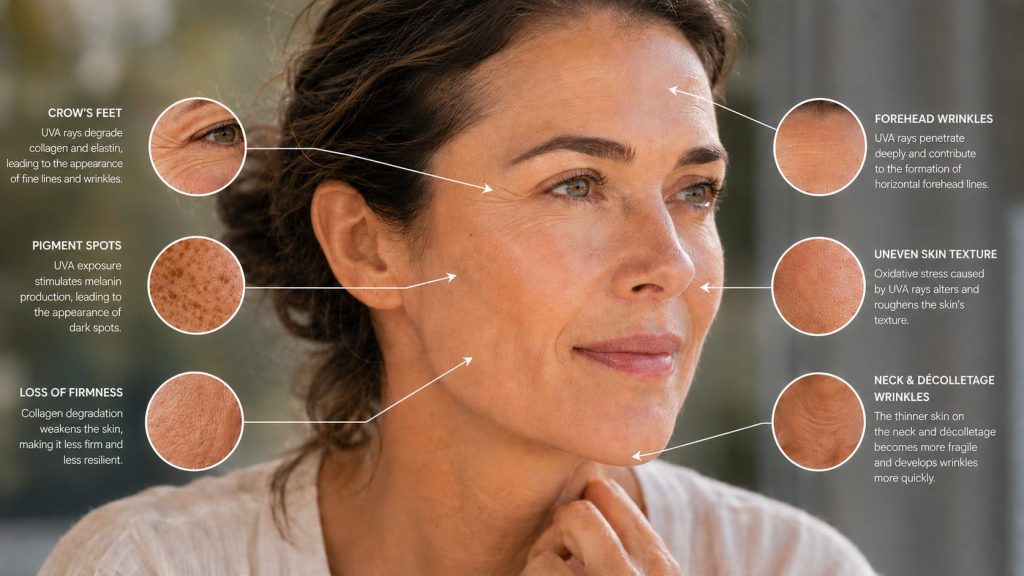
A tan gives the illusion of healthier skin, whilst the damage mechanisms described above continue to take effect deep within the skin throughout the duration of exposure. It is this discrepancy between the immediate appearance and the actual impact on collagen that explains why the true extent of the damage usually becomes apparent in the autumn, once the tan has faded.
The good news is that this isn’t inevitable. A few simple habits, practised throughout the summer, are enough to significantly limit the damage.
It is impossible to completely prevent summer damage, but it is entirely possible to limit its impact on the skin’s collagen levels. Here are the habits that really make a difference.
Broad-spectrum sun protection (UVA/UVB), with an SPF of 30 to 50, remains the most effective way to slow down collagen breakdown. It should be applied every morning, even on overcast days, and reapplied every two hours during prolonged exposure.
Well-hydrated skin is better able to withstand external stresses. A cream containing hyaluronic acid or glycerine helps to minimise water loss caused by heat and wind.
Salt and chlorine weaken the hydrolipidic film that naturally protects the skin. A shower with plain water after every swim, followed by a moisturiser, helps to minimise this daily damage.
Red berries, citrus fruits, colourful vegetables and green tea: these foods help the body neutralise the excess free radicals produced by UV rays and support the skin’s natural defences.
It is mainly at night that the skin regenerates. A good night’s sleep supports fibroblast activity and, consequently, the body’s natural production of collagen.
Collagen and vitamin C play a complementary role here. We explain this in more detail in the following section.
Among the nutrients essential for maintaining collagen levels, vitamin C plays a particularly important role.
From a biochemical perspective, vitamin C plays a direct role in collagen synthesis: it is essential for the hydroxylation of proline, a key step that stabilises the protein’s triple-helix structure. Without an adequate supply, this synthesis is slowed down.
It is on this basis that the European Food Safety Authority (EFSA) recognises that vitamin C contributes to the normal formation of collagen to ensure the normal functioning of the skin, cartilage, bones, gums, teeth and blood vessels.
A study conducted by the University of Otago (New Zealand), published in late October 2025, examined the effect of increased dietary intake of vitamin C in healthy adults in New Zealand and Germany. Participants who increased their vitamin C intake to around 250 mg per day saw their skin vitamin C levels rise in line with their blood levels.
The researchers observed, in these same participants, an increase in skin thickness – a marker associated with greater collagen production – as well as faster renewal of epidermal cells. It is worth noting that vitamin C obtained from the diet effectively reaches all layers of the skin via the bloodstream, whereas topical application finds it more difficult to penetrate the skin barrier.
Référence : Pullar J.M. et al. Improved Human Skin Vitamin C Levels and Skin Function after Dietary Intake of Kiwifruit. Journal of Investigative Dermatology. 2025.
→ View the study: https://www.sciencedirect.com/science/article/pii/S0022202X25021371
Good to know
Vitamin C contributes to the normal formation of collagen to ensure the skin functions normally. Some dietary supplements combine collagen peptides and vitamin C to bring these two ingredients together in a single formula, as a complement to a varied and balanced diet.
This is what scientific studies show
The mechanisms described in this article are now well documented in the scientific literature. Several journals published in a number of journals international leading reference confirm the role of UV rays in the photo-ageing process and the degradation of collagen.
UV rays activate the enzymes responsible for the breakdown of collagen.
A review published in the International Journal of Molecular Sciences shows that UV rays increase the expression of matrix metalloproteinases (MMPs), enzymes that break down collagen and other proteins essential to the structure and maintenance of the skin.
Pittayapruek P. et al. Role of Matrix Metalloproteinases in Photoaging and Photocarcinogenesis. International Journal of Molecular Sciences. 2016.
→ View the study: https://www.mdpi.com/1422-0067/17/6/868
UVA rays promote oxidative stress and disrupt fibroblasts
A scientific journal published in 2021 explains that UVA rays promote the production of free radicals in the dermis and impair the functioning of fibroblasts, thereby contributing to photoageing of the skin.
Wang H. et al. Photoaging: Mechanisms and Prevention. 2021.
→ View the study: https://pmc.ncbi.nlm.nih.gov/articles/PMC8597149/
Repeated exposure gradually reduces collagen levels
A review published in 2025 confirms that repeated exposure to UV rays leads to a gradual reduction in the amount of collagen present in the skin. This loss is associated with a reduction in firmness, a decrease in elasticity and a more pronounced appearance of wrinkles.
Photoaging and Skin Extracellular Matrix Remodeling. 2025.
→ View the study: https://pmc.ncbi.nlm.nih.gov/articles/PMC12018068/
The latest research confirms the central role of MMPs
A review published in 2024 highlights that matrix metalloproteinases (MMPs) play a key role in the mechanisms responsible for UV-induced skin ageing and the degradation of collagen fibres.
Matrix Metalloproteinases in Skin Aging. 2024.
→ View the study: https://pmc.ncbi.nlm.nih.gov/articles/PMC11626319/
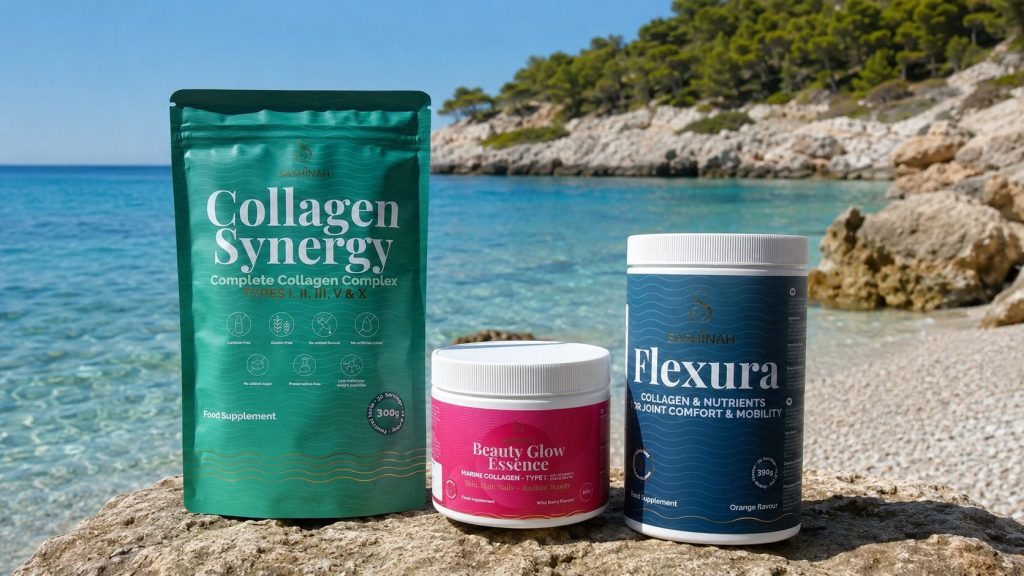
Discover our collagen products SASHINAH®
Would you like to incorporate collagen into your daily routine? Discover the range of SASHINAH® dietary supplements, developed using carefully selected ingredients to meet a variety of needs.
→ Discover our collagen products SASHINAH®
Does the collagen lost during summer return naturally?
Collagen production never stops completely, but it gradually slows down with age and repeated damage. Appropriate sun protection, good hydration, a balanced diet and an adequate intake of vitamin C – which contributes to the normal formation of collagen – all help to maintain the skin’s quality in the long term.
Is sun cream enough to protect collagen?
Sun protection is the first step to take, but it is not enough on its own. Heat, wind, sea salt and chlorine can also damage the skin. Broad-spectrum sun protection, combined with proper moisturising and rinsing off after every swim, helps to minimise these harmful effects.
Should you avoid the sun altogether in summer?
No. The aim is to expose yourself to the sun in a sensible way: choose times when the sun’s rays are less intense, apply suitable sun protection and avoid prolonged exposure without protection. It’s not about avoiding the sun, but about adopting the right habits.
Are collagen supplements useful in summer?
They can complement a balanced diet and a skincare routine. Formulas combining collagen with vitamin C are of particular interest, as vitamin C contributes to the normal formation of collagen to ensure the skin functions normally. However, they are not a substitute for essential daily skincare routines.
Does a tan protect against UVA rays?
No. Tanning is a natural defence mechanism of the skin against UV rays, but it does not provide sufficient protection. UVA rays continue to penetrate deeply and contribute to photoageing, even when the skin is tanned.
How long does it take to see the effects of good skin protection?
The benefits of a regular routine involving sun protection, moisturising and a healthy lifestyle become apparent gradually, usually over several weeks. Consistency is more important than one-off measures when it comes to maintaining the skin’s quality in the long term.
Summer is the season when collagen is most exposed to external aggressors. UVA rays, heat, salt, chlorine, wind and oxidative stress all work together – often invisibly – before gradually becoming apparent in the form of drier, less firm and less elastic skin.
The good news is that these effects are not inevitable. Appropriate sun protection, good hydration, a diet rich in antioxidants and an adequate intake of vitamin C all help to maintain the skin’s quality in the long term.
By looking after your skin throughout the summer, you’re not just protecting your tan: you’re also helping to preserve your collagen levels and minimise the long-term effects of photo-ageing.